I’m currently working on another painting loosely based on the subject of Shakespeare’s Ophelia. She is a young woman in his play, Hamlet. Ophelia’s life is gradually destroyed by the men around her, ending in her decline into “madness”, and ultimately her death. She is a symbol of innocence and vulnerability. And she is manipulated for political gain and strategic advantage. Her identity being dictated to her by the male members of her family, who control her every move.
Hamlet is a tale of the oppression of women in a patriarchal society but I also see it as a story with a wider meaning beyond its literal plot, it could be read as an allegory for the oppression of the natural world - by a small handful of men, subjugating the resources of the world for their own gain and political control. You could switch the name of “Ophelia” for “planet earth” - they could be totally interchangable in this context.
This theory is just a hunch of mine and the reading of this story as a new kind of allegory. To further bolster this idea as a modern interpretation of the character of Ophelia in Shakespeare’s play, I recently came across this quote by the academic and author, Stephanie E. Chatfield in her Ophelia in Culture essay, she writes;
“Ophelia is one of the most haunting figures in literature. She was born in Shakespeare’s Hamlet and reborn across centuries of art, poetry, film, and culture. Part of her lasting power is that every age seems to find its own reflection in her.”
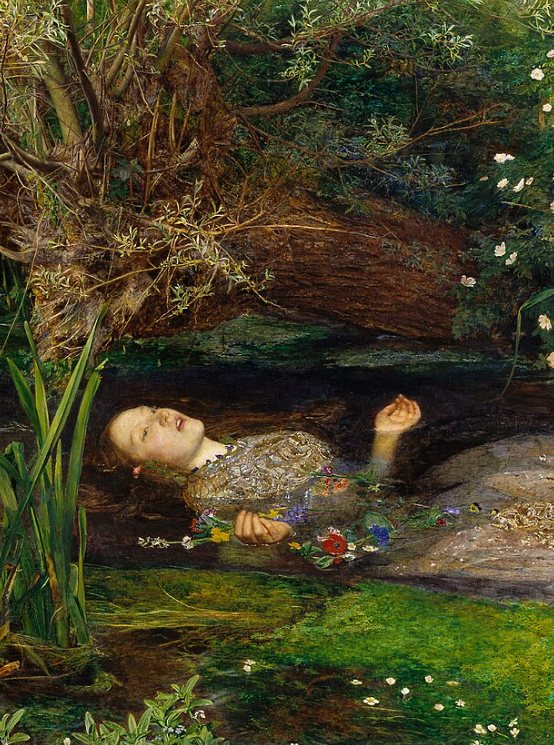
The fascination of this subject matter, and the creation of the most famous of Victorian paintings, Ophelia by John Everett Millais, is another example of the interpretation of the story of Ophelia as allegory. The Pre-Raphaelites were obsessed with her;
“Nature Surrounds Ophelia, and Nature Was Their (the Pre-Raphaelites) Sacred Language:
When Ophelia falls into the river, she becomes part of the landscape. The flowers she carries, the water that holds her, the willow branch, they’re all symbols Shakespeare chose with care. The Pre-Raphaelites revelled in this natural vocabulary.
Millais famously painted the background of Ophelia first, on location, capturing moss, lilies, violets, forget-me-nots, river weeds - carefully observed English flora. This devotion to nature was part of the movement’s rebellion against the dark, idealised canvases of the Royal Academy (and the dark oppression of the world they saw around them during the era of the industrial revolution). Ophelia allowed them to merge human emotion with the living world.” Stephanie E. Chatfield
I’ve found this an encouraging read, supporting my theory of Ophelia as allegory for the climate crisis. And as each time period sees something different, Ophelia continues to be a mirror for our deepest and darkest concerns and reflections on contemporary life. It would seem Ophelia is an ever potent allegory, for us all to interpret, in every era.